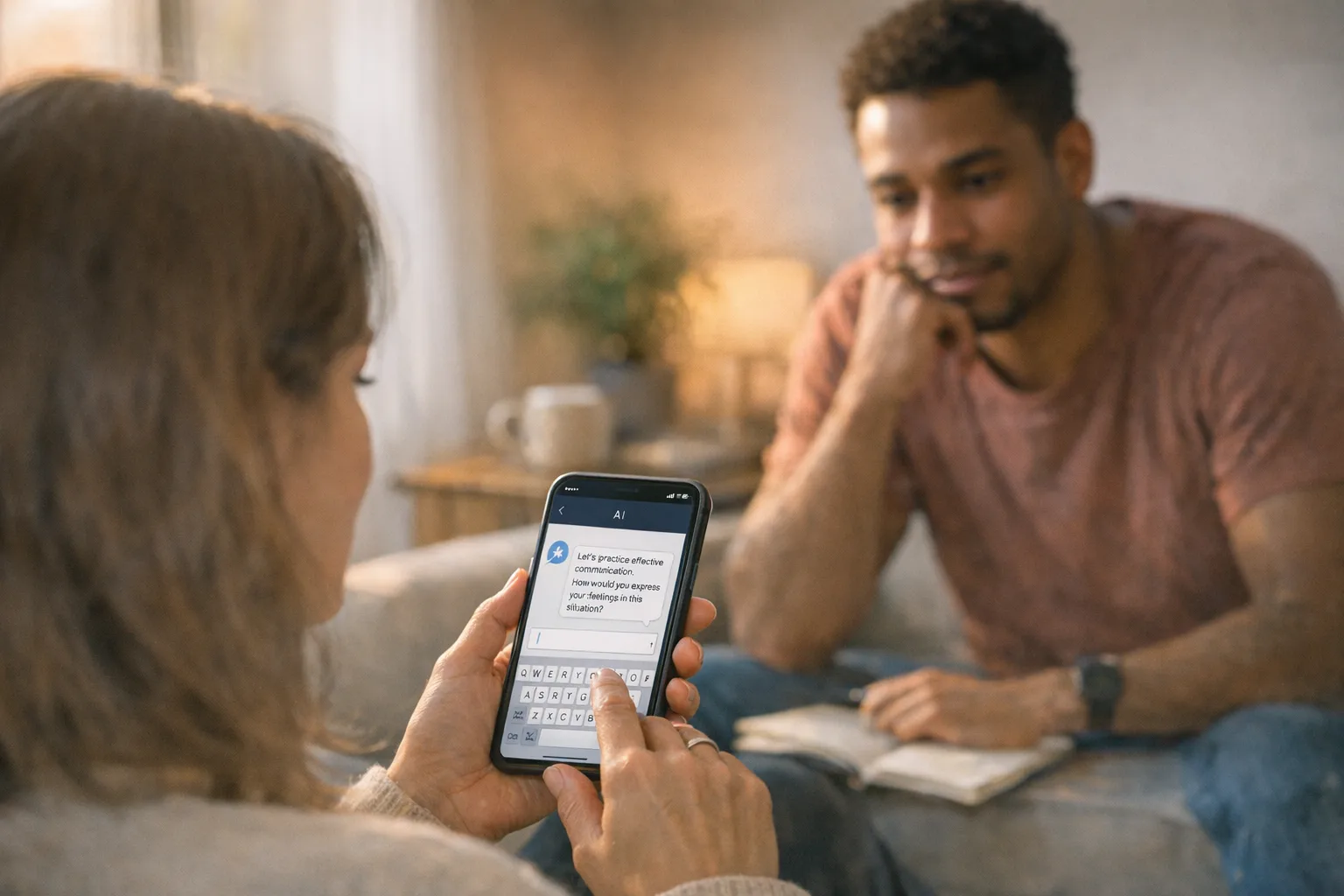
The Risks of Using AI to Replace Human Connection
AI is becoming part of everyday life. People use it to draft difficult texts, process emotions, rehearse conversations, and even seek comfort late at night when no one is available. There is a real reason for that. AI can be fast, private, nonjudgmental in tone, and easy to access.
Used thoughtfully, it can be helpful. In fact, we have written elsewhere about where technology can genuinely support reflection and relational growth, including /ai-therapy and /blog/how-to-use-ai-between-therapy-sessions-to-build-real-relationship-skills. The problem begins when a tool that can support connection starts to replace it.
Human connection is not just the exchange of information. It is being known by someone who has a body, a history, a nervous system, limits, needs, and care. It is the experience of mutual influence: I affect you, and you affect me. That is where intimacy, repair, trust, and growth actually happen.
When people begin leaning on AI instead of relationships, the costs are often subtle at first. It can feel easier, cleaner, and safer. But over time, it may reduce emotional courage, increase avoidance, and create the illusion of being understood without the reality of being in relationship.
For couples and individuals who want stronger relationships, this distinction matters. AI may help you think. It cannot love you back, challenge you from a place of real care, or share the vulnerability that makes closeness possible.
Why AI can feel easier than people
Before talking about the risks, it helps to understand the appeal. Many people are not choosing AI because they are shallow or uninterested in relationships. They are choosing it because relationships can be hard.
- AI is available instantly. There is no waiting for someone to text back.
- AI feels emotionally efficient. You can ask for support without worrying about burdening anyone.
- AI can sound validating. It often responds in a calm, affirming way.
- AI can be customized. It can mirror your preferred tone, style, and pace.
- AI feels lower risk. It will not reject you, get defensive, or remember your worst moment in the way a person might.
If you have a history of conflict, shame, loneliness, or emotional neglect, this can be especially compelling. A predictable tool may feel safer than an unpredictable person.
That does not make AI bad. It does mean that overreliance on it can quietly reinforce the very patterns that keep people disconnected.
The central risk: simulation can start to stand in for relationship
One of the biggest dangers is not that AI is obviously harmful. It is that it can be convincing enough to feel relational without actually being a relationship.
An AI response may sound empathic. It may reflect your feelings back clearly. It may even help you organize your thoughts better than the average rushed friend. But empathy language is not the same as lived empathy. A generated response is not the same as shared presence.
In real connection, another person has their own subjectivity. They misunderstand you sometimes. They surprise you. They ask for things from you. They have needs that do not perfectly align with yours. That friction is not a design flaw. It is part of what develops maturity, reciprocity, and genuine closeness.
When AI becomes the easier substitute, people can begin preferring a relationship that asks nothing of them over relationships that require patience, honesty, repair, and compromise.
Comfort is not always the same thing as connection. Sometimes what feels smoother in the moment leaves us weaker in relationship over time.
Risk 1: emotional avoidance gets stronger
Many relationship struggles are maintained by avoidance. We avoid saying the hard thing. We avoid tolerating discomfort. We avoid hearing feedback that might sting. We avoid the vulnerability of not knowing how someone will respond.
AI can become a very sophisticated avoidance strategy.
Instead of telling your partner you feel lonely, you process it with AI for an hour and never bring it up. Instead of calling a friend after a painful day, you ask a chatbot for reassurance. Instead of working through conflict with a real person, you keep refining your private interpretation of events with a tool that cannot truly challenge your relational stance in the way a trusted human can.
This matters because emotional courage is like a muscle. If you repeatedly choose low-risk simulation over real relational risk, your capacity for direct, honest connection may shrink.
If this pattern sounds familiar, articles like /blog/building-stronger-relationships-through-effective-communication and /how-to-stop-fighting may help you strengthen the real-world skills that AI cannot build on its own.
Risk 2: you may become less tolerant of real human imperfection
AI can be endlessly patient in tone. It does not get tired, distracted, hungry, stressed, or triggered. Human beings do.
If someone gets used to a form of interaction that is highly responsive and tailored, ordinary human relating can start to feel disappointing. A partner may seem too slow. A friend may seem too blunt. A therapist may seem less instantly gratifying because they do not simply validate; they also observe patterns, offer nuance, and sometimes say things you do not want to hear.
Over time, a person can drift into an unrealistic comparison: AI feels easier, so people must be the problem.
But healthy relationships are not built on frictionless responsiveness. They are built on resilience, repair, and the ability to stay connected even when there is misattunement. If you want durable intimacy, learning to work with imperfection is essential.
Risk 3: confirmation can replace accountability
AI often reflects the frame you bring to it. If you ask, “Why is my partner so selfish?” you may get a polished answer that helps you build a case. If you ask, “Am I overreacting?” you may get nuance, but you are still guiding the interaction.
This can create a subtle echo chamber. Instead of being challenged by someone who knows you well and is willing to risk your irritation, you may repeatedly receive responses shaped by your wording, your assumptions, and your emotional state in that moment.
That is very different from accountability. In strong relationships, growth often comes when someone trustworthy helps us see our part. That is not always comfortable, but it is often necessary.
If you notice a pattern of using tools to strengthen your certainty rather than deepen your self-reflection, it may be worth reading /blog/is-everyone-in-your-life-the-problem-maybe-you-re-part-of-it.
Risk 4: intimacy without mutuality is a dead end
One reason human connection matters so much is that it is mutual. Real intimacy involves giving and receiving. You reveal yourself, and someone else reveals themselves. You respond to one another. You matter to each other.
AI can mimic one side of that equation. It can invite disclosure. It can create the feeling of being heard. But there is no mutual vulnerability. The “relationship” does not require care, responsibility, repair, or ethical consideration in the way a human bond does.
That matters because mutuality is not optional in love. Couples who thrive learn not only to express themselves but also to remain engaged with another person’s inner world. That is part of what makes a relationship living rather than performative.
When people spend more of their emotional lives in one-way interactions, they may slowly become less practiced in the give-and-take that closeness requires.
Risk 5: AI can interfere with couple dynamics in quiet ways
In couple relationships, overreliance on AI can introduce a third presence into the bond. Sometimes that looks harmless at first. One partner uses AI to vent after arguments. Another asks AI to interpret the other person’s motives. Someone starts drafting emotionally loaded texts with a chatbot rather than speaking more directly.
The issue is not simply the tool. It is what the tool starts to replace.
- Direct conversation gets delayed.
- Private certainty grows faster than shared understanding.
- Conflict can become more strategic and less authentic.
- Partners may feel managed rather than met.
There is also a triangulation risk: instead of bringing distress into the relationship in a workable way, a person takes it outside to a system that cannot fully understand the history, context, tone, or embodied experience of the relationship. If that sounds familiar, /blog/triangulation-in-relationships-why-it-hurts-conflict-and-what-to-do-instead may be useful.
Risk 6: loneliness can be masked rather than addressed
One of the saddest possibilities is that AI may reduce the pain of loneliness just enough that people postpone doing what would actually change it.
A person who feels emotionally isolated may get temporary relief from an AI conversation. That relief is real in the short term. But if it substitutes for reaching toward community, friendship, partnership, therapy, coaching, or family repair, loneliness remains fundamentally untreated.
This is especially important for people who already struggle to ask for help. Temporary soothing can become a holding pattern.
There is a meaningful difference between feeling less alone for a moment and becoming less alone in your life.
Risk 7: sensitive or complex issues need human judgment
Relationships involve context, history, culture, power, attachment patterns, trauma, and values. AI can offer general guidance, but it does not truly know your life. It cannot read body language, notice subtle fear, understand the silence between two people in a room, or hold ethical responsibility in the way a trained professional does.
This becomes especially important when there is coercion, abuse, serious mental health strain, addiction, infidelity, or major life decisions on the line. In those moments, human support matters. A trusted friend, coach, therapist, physician, or crisis service may offer the discernment and accountability that a tool cannot.
If you are weighing support options, /coaching-vs-therapy and /what-to-expect-in-therapy can help clarify what kind of help may fit best.
What healthy AI use can look like
None of this means you need to avoid AI completely. For many people, a more balanced approach is possible and useful.
Healthy use usually looks like support that points you back toward human life rather than away from it.
- Use AI to prepare for a real conversation, not replace it.
- Use it to organize thoughts, identify feelings, or practice calmer wording.
- Ask it to help you consider your part, not just confirm your position.
- Notice when you are using it because you feel scared, ashamed, or avoidant.
- Set limits if it starts taking the place of reaching out to actual people.
A helpful question is: Is this tool helping me show up more honestly with people, or helping me hide from them more elegantly?
How to tell if AI is replacing connection in your life
You may want to pause and reflect if any of these feel true:
- You turn to AI first and people second for emotional support.
- You have fewer vulnerable conversations than you used to.
- You feel more understood in AI exchanges than in your actual relationships, but you are doing less to improve those relationships.
- You use AI to avoid burdening others, but your loneliness is growing.
- You increasingly prefer controlled, one-way interactions over messy human ones.
- You use AI after conflict to strengthen your case rather than reopen dialogue.
These are not reasons for shame. They are signals. Usually, they point to a need for safer, stronger, more skillful human connection.
What to do instead if you want more real connection
1. Choose one person and be more honest than usual
You do not need to overhaul your social life in a week. Start with one real conversation. Say what is actually true: “I’ve been feeling more alone than I admit,” or “I notice I keep processing things privately instead of talking to you.”
2. Practice tolerating imperfect responses
The first goal is not getting a flawless reaction. The goal is staying in contact with reality. Real people may stumble. Give the conversation a little room before deciding it failed.
3. Use AI as a bridge, not a destination
If AI helps you calm down, name feelings, or draft a starting point, that is fine. Then take the next step with an actual person.
4. Build communication skills deliberately
Many people do not avoid connection because they do not care. They avoid it because they do not feel skilled enough. Skills can be learned. Resources like /for-couples, /blog/building-emotional-intelligence-for-stronger-relationships, and /blog/how-to-repair-after-a-fight-in-10-minutes-using-rlt-strategies can help.
5. Get support when patterns feel stuck
If you and your partner keep missing each other, or if you find yourself relying on AI because human connection feels confusing, painful, or exhausting, outside support may help. The goal is not dependency. It is learning how to create more honest, regulated, workable connection in real life.
The bottom line
AI can be a useful tool. It can help with reflection, emotional language, preparation, and support between conversations. But it becomes risky when it starts replacing the discomfort, reciprocity, accountability, and vulnerability that real connection requires.
People grow in relationships with other people. We learn by being seen, challenged, loved, disappointed, forgiven, and repaired with. No technology can fully substitute for that.
If you want stronger relationships, the task is not to reject useful tools. It is to keep choosing reality over simulation, even when reality is messier.
If you want support building more honest, connected relationships, Strong & Connected offers practical, therapy-informed coaching for individuals and couples. You can learn more about the approach on /about or book a consultation at /contact.
Frequently Asked Questions
Can AI replace human connection in relationships?
No. AI can offer reflection, structure, and temporary comfort, but it cannot provide mutual vulnerability, real accountability, or the lived reciprocity that healthy relationships require.
What are the main risks of relying on AI for emotional support?
The biggest risks are emotional avoidance, growing intolerance for normal human imperfection, increased self-confirmation without accountability, and masking loneliness instead of addressing it through real relationships.
Is it unhealthy to talk to AI instead of my partner or friends?
Not always, but it can become unhealthy if it regularly replaces direct conversations, reduces your emotional honesty, or keeps you from reaching out to real people when connection is what you actually need.
How can I use AI in a healthy way without harming my relationships?
Use it to organize thoughts, name feelings, or prepare for a conversation, then bring those insights into a real interaction with your partner, friend, coach, or therapist.
When should I seek human support instead of using AI?
Seek human support when the issue is emotionally significant, repetitive, or high stakes, especially in cases involving relationship distress, abuse, infidelity, addiction, mental health concerns, or major life decisions.