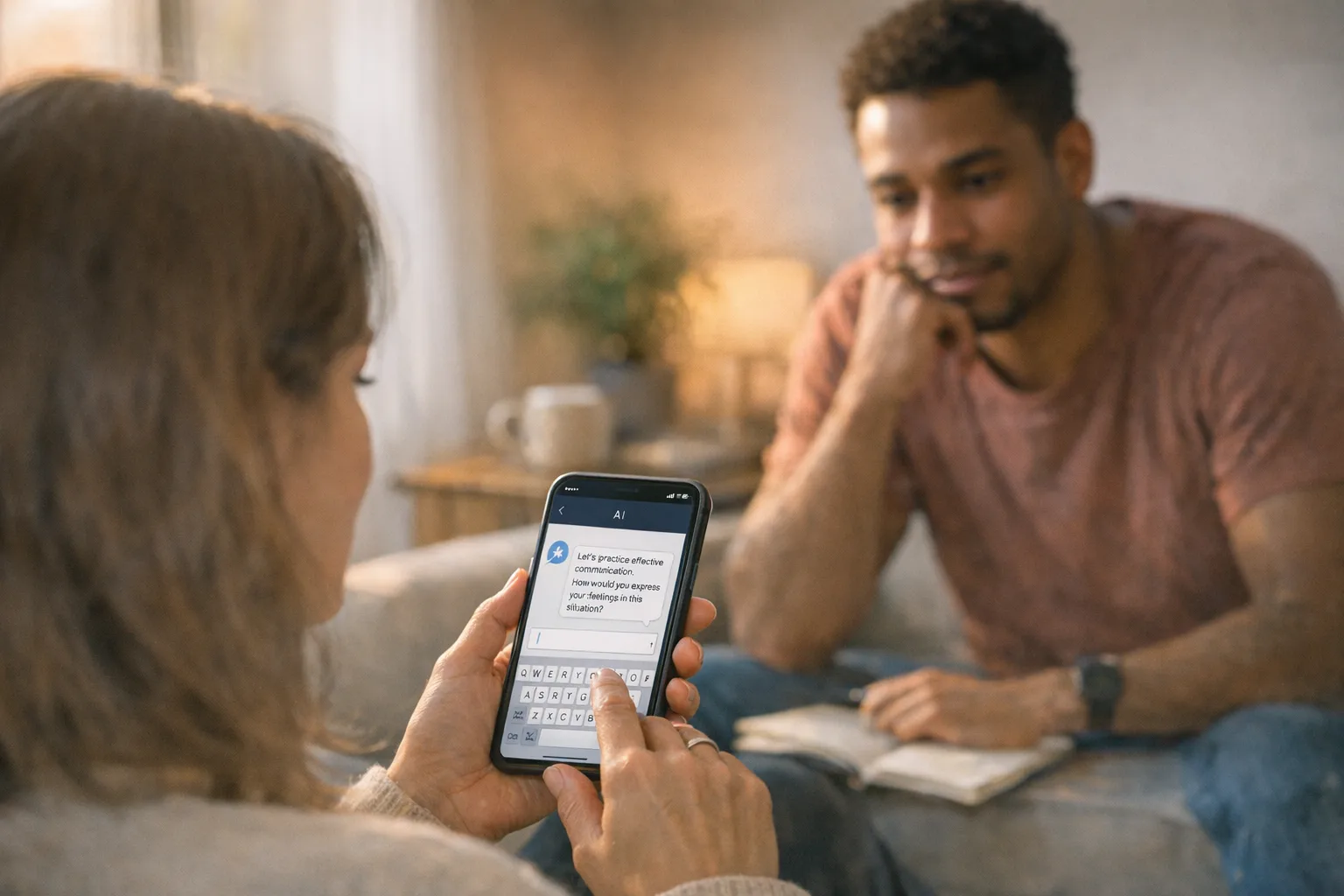
The Pros and Cons of AI Therapists
More people are quietly asking a question that would have sounded unusual not long ago: can an AI therapist actually help?
It is a fair question. Many individuals and couples are overwhelmed, lonely, financially stretched, or unsure where to begin. Waiting lists can be long. Opening up to a stranger can feel intimidating. And when distress hits at 11 p.m., a chatbot is often easier to reach than a human professional.
There is no need to approach this conversation with panic or cynicism. AI therapy tools are not automatically harmful, and they are not magical either. Like many technologies, they can be useful in some situations and inadequate in others. The real task is learning how to think clearly about them.
For people seeking stronger relationships, emotional steadiness, and practical support, a balanced view matters. AI can sometimes help you pause, reflect, organize your thoughts, and practice healthier communication. But it can also miss nuance, overstate certainty, or fail to respond appropriately when pain becomes layered, relational, or high risk.
If you are curious about the broader intersection of technology and support, you may also find /ai-therapy and /connection-in-digital-age helpful starting points.
What people mean by an “AI therapist”
Most AI tools are not therapists in the traditional sense. They do not hold licensure, human accountability, lived experience, or genuine relational presence. Usually, people are referring to chatbots or apps that simulate therapeutic conversation, offer coping prompts, suggest journaling exercises, or guide users through structured mental health content.
Some tools are designed for mood tracking or cognitive exercises. Others are positioned more directly as emotional companions. A few are integrated into care systems and may support human clinicians rather than replace them.
That distinction matters. There is a big difference between a tool that helps you identify patterns and a trained human who can recognize trauma responses, relational dynamics, avoidance, shame, coercion, grief, or subtle emotional dysregulation in real time.
The real pros of AI therapists
1. Immediate access
One of the biggest advantages is availability. AI tools are often accessible 24/7. If someone is spiraling late at night, feeling alone after an argument, or too anxious to book a first appointment, immediate support can feel relieving.
That kind of access does not replace care, but it can create a useful pause between emotional activation and impulsive action. For some people, that pause is meaningful.
2. Lower barrier to starting
Many people hesitate to begin therapy because they fear judgment, do not know how to describe what they are feeling, or worry they are “overreacting.” Talking to AI can feel less exposing at first. It may help someone put language to their experience before they speak with a real person.
For individuals who have difficulty naming emotions, the early structure can be helpful. If that sounds familiar, /blog/building-emotional-intelligence-for-stronger-relationships offers practical support for strengthening this skill.
3. Cost and convenience
AI tools are often cheaper than ongoing therapy, and sometimes free. For people navigating financial pressure, caregiving, demanding work schedules, or life in a high-stress city, convenience matters.
Being able to check in from home, during a lunch break, or after a difficult conversation can make support feel more realistic and sustainable.
4. Help with reflection and communication practice
Some AI tools can help users journal, summarize feelings, prepare for hard conversations, or identify recurring triggers. For couples, this can occasionally support better preparation before talking through conflict.
For example, an AI tool may help someone slow down enough to ask: What am I actually hurt about? What do I want my partner to understand? What am I assuming? That reflective step can lower defensiveness and increase clarity.
In that sense, AI can function a bit like a worksheet, prompt library, or structured mirror. Used carefully, that can be useful.
5. Reduced stigma for some users
Some people still carry significant shame around seeking help, especially men, adolescents, and people raised to minimize emotion. Private, low-pressure tools may make support feel more approachable.
That does not mean AI is the best long-term answer. It does mean it can be a bridge. Sometimes the first safe conversation, even with a tool, helps someone become more open to real support later. Readers interested in this dynamic may appreciate /mens-mental-health or /for-men.
The real cons of AI therapists
1. No genuine human relationship
This is the biggest limitation. Healing often happens not just through information, but through relationship: being seen accurately, challenged thoughtfully, and responded to by someone who can feel the emotional moment with you.
An AI system can imitate empathy in language. It cannot offer true attunement, ethical judgment, or embodied human presence. For relational pain, that difference matters a great deal.
If you are dealing with recurring conflict, emotional withdrawal, resentment, trust injuries, or a sense that your relationship keeps circling the same painful patterns, human support is usually far more effective than a chatbot. You can explore options at /for-couples or read /blog/do-we-need-couples-therapy-or-is-it-too-late.
2. It can miss nuance
Relationships are rarely simple. A partner who seems “angry” may actually be terrified. A person who says “I’m fine” may be flooded with shame. A conflict about dishes may really be about power, exhaustion, invisibility, or old attachment wounds.
AI can recognize patterns in language, but it does not truly understand context the way a skilled therapist can. It may provide polished responses that sound helpful while missing the core issue entirely.
This can leave users feeling oddly supported and unseen at the same time.
3. Risk in high-stakes situations
AI tools are not reliable substitutes for crisis care, trauma-informed treatment, or support where safety is a concern. If someone is experiencing suicidality, abuse, coercive control, severe depression, mania, addiction, trauma activation, or escalating relational harm, a chatbot is not enough.
Even outside crisis, some situations require careful clinical discernment. A human can notice contradictions, assess danger, and adapt with moral and emotional responsibility. AI cannot carry that responsibility in the same way.
4. Advice can be generic, inaccurate, or overconfident
One challenge with AI is that it often sounds confident even when it is simplifying. It may offer broad communication tips without understanding the personalities, histories, culture, trauma, or power dynamics involved. That can be frustrating at best and harmful at worst.
For example, “just communicate openly” is not enough when one partner shuts down under pressure, the other escalates quickly, and both are carrying years of unresolved hurt. Real guidance needs specificity, pacing, and accountability.
5. Privacy and data concerns
This concern is not always discussed openly enough. When you share vulnerable personal information with an app, it is reasonable to ask what happens to that data, how it is stored, whether it is reviewed, and what protections actually exist.
People in emotional pain are often more likely to disclose highly personal material quickly. Before using any AI mental health tool, it is wise to read the privacy terms carefully and think about your comfort level.
Where AI can be helpful in relationships
AI can be useful as a support tool around the edges of growth. It may help you:
- clarify what you are feeling before a difficult conversation
- brainstorm calmer language for a repair attempt
- track recurring conflict patterns
- practice naming needs, fears, and boundaries
- reflect after an argument instead of reacting impulsively
In those roles, AI is less like a therapist and more like a structured companion for reflection.
For example, after a fight, someone might use a tool to slow down and identify the difference between the trigger and the deeper wound. That can create a more grounded conversation later. If you are working on practical repair, /blog/how-to-repair-after-a-fight-in-10-minutes-using-rlt-strategies may help.
Where human therapy or coaching is usually better
Human support is usually the better fit when:
- the same conflict keeps repeating without resolution
- trust has been damaged
- you feel stuck between staying and leaving
- there is chronic resentment, contempt, or emotional shutdown
- past trauma is shaping present reactions
- one or both partners feel deeply alone in the relationship
- you want not just coping, but meaningful relational change
A trained therapist or coach can help identify the pattern underneath the pattern. They can slow both people down, challenge distortions, name accountability issues, and support genuine repair. That kind of work is difficult to replicate with a tool.
If you are unsure which kind of support makes sense, /coaching-vs-therapy and /what-to-expect-in-therapy can offer clarity.
A balanced way to think about AI therapists
The most grounded view is this: AI can be useful, but it should be kept in proportion.
It may help with reflection, emotional vocabulary, preparation, psychoeducation, and accessible first-step support. It is often strongest as a supplement. It is weakest when people need depth, nuance, accountability, crisis assessment, or genuine relational healing.
In other words, AI may help you organize your thoughts. It cannot truly join you in the work of becoming more honest, more regulated, more compassionate, and more responsible in love.
Use AI for support, reflection, and skill-building. Do not ask it to carry the full weight of your healing, your safety, or your relationship.
How to decide what is right for you
If you are considering an AI therapy tool, a few questions can help:
- Am I looking for convenience, or am I avoiding the vulnerability of real help?
- Is my situation relatively straightforward, or is it emotionally complex?
- Do I need ideas and structure, or do I need attuned human feedback?
- Are there safety, trauma, addiction, or high-conflict issues involved?
- Would this tool help me take the next step, or keep me from taking it?
There is no shame in starting small. If AI helps you name what hurts, that may be valuable. But if you already know that your pain is persistent, your relationship is strained, or your inner world feels harder to manage than a tool can hold, that is important information too.
Final thoughts
People are not wrong for being curious about AI therapists. The need underneath that curiosity is often deeply human: relief, clarity, privacy, affordability, and the hope of feeling less alone.
That hope deserves respect.
At the same time, many of the hardest parts of life and love require more than well-worded responses. They require presence, discernment, honesty, and care that can meet the full complexity of being human.
If you are trying to figure out whether AI support, coaching, or therapy makes the most sense for you or your relationship, Strong & Connected can help you think it through. If you are ready for a more personal conversation, book a consultation.
Frequently Asked Questions
Are AI therapists actually helpful?
They can be helpful for reflection, journaling, emotional check-ins, and practicing communication. They are usually best used as a supplement, not a replacement for human care.
What are the biggest risks of using an AI therapist?
The main risks are missed nuance, generic or inaccurate advice, privacy concerns, and poor support in crisis or high-conflict situations. Complex emotional or relationship issues usually need human judgment.
Can AI therapy help couples?
Sometimes, yes. It can help partners clarify feelings, prepare for conversations, and notice patterns. But ongoing conflict, trust injuries, and deeper relational wounds are usually better addressed with a trained human professional.
Is AI therapy a replacement for a real therapist?
For most people, no. AI can offer convenience and structure, but it cannot provide genuine attunement, clinical judgment, or the depth of a real therapeutic relationship.
How do I know whether I need AI support or human therapy?
If you want basic reflection tools, AI may be enough for a starting point. If your distress is persistent, your relationship is stuck, or safety, trauma, or trust issues are involved, human therapy or coaching is the better choice.